
June,20 2026 | Written By Akratijewelsinc
June,20 2026 | Written By Akratijewelsinc
Starting a jewelry brand used to mean either spending a lot of money upfront or settling for whatever mass-produced pieces a local distributor had sitting in a warehouse. Neither option was great. The first was risky. The second made it nearly impossible to build anything that felt like your own brand.
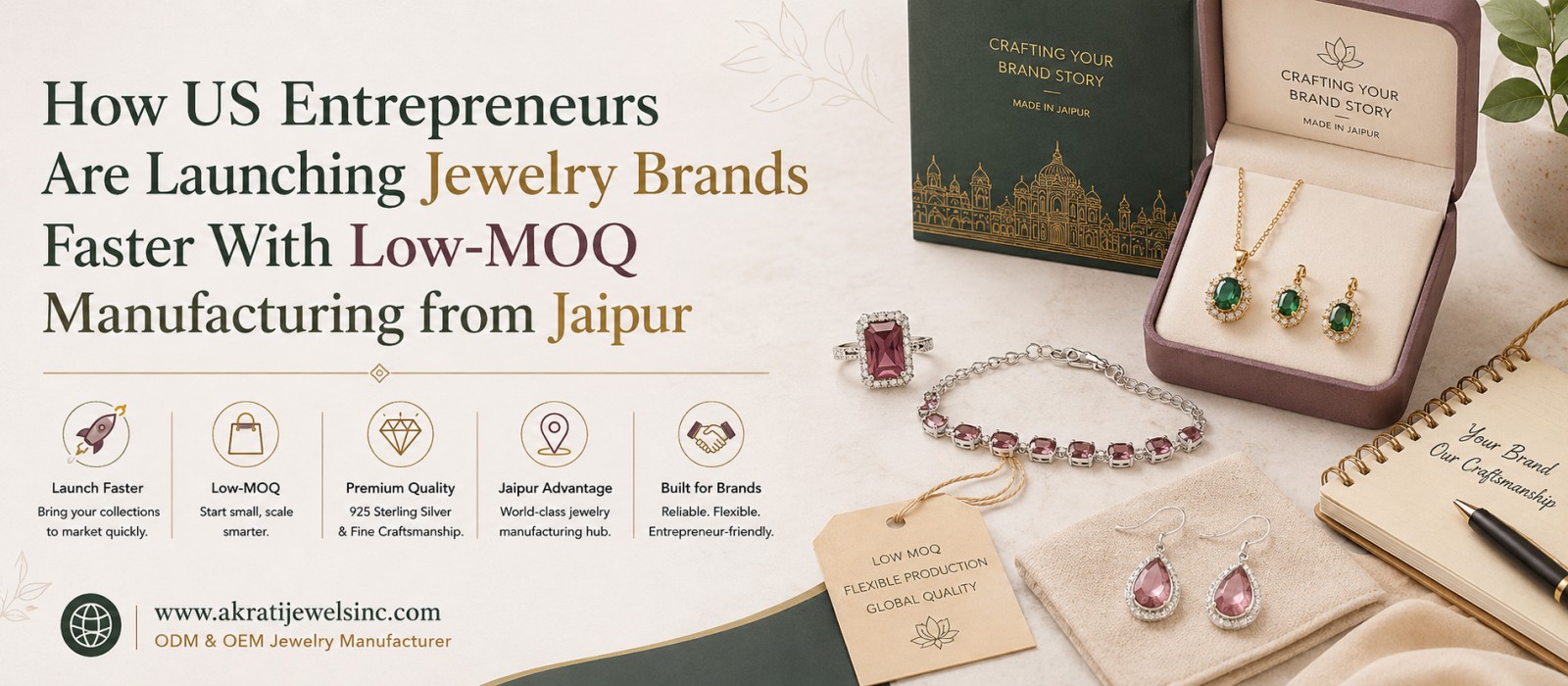
That is changed. A lot of US entrepreneurs, Etsy sellers, boutique owners, Instagram brands are now sourcing jewelry directly from Jaipur with small opening orders and building real jewel businesses from there. Here is how it actually works.
Jaipur isn't just a city with gemstone jewelry manufacturers; it's the place where a huge portion of the world's gemstone cutting and silver jewelry gets made. The craft knowledge here goes back generations. Stone cutters, silver smiths, setting specialists, these are people who grew up in this trade, watched their parents do it, and learned by doing it themselves for years. You can't replicate that with a factory setup that opened two years ago.
For US brands, sourcing from a gemstone jewelry manufacturer in Jaipur means getting access to that depth of craft at a price that actually makes retail margins work. That combination is genuinely hard to find anywhere else.
Traditional wholesale meant buying in bulk before you knew what sold. A lot of brands burned early capital on inventory that sat and eventually got discounted out. Low MOQ jewelry manufacturing in India changed the risk equation entirely. You can begin by ordering around 20-30 pieces per style, analyzing what your custom traffic actually respond to, then dig deeper into the winners.
This is a particularly useful model for jewelry startups in India, brands selling through Instagram, TikTok shops, or Etsy – avenues where you can test the demand before scaling up production.
Across the US retail brands we work with at Akrati Jewels, a few categories consistently outperform for new sellers. Sterling silver rings, especially stackable styles and gemstone solitaires, are safe openers because they have broad appeal and straightforward pricing. Layering necklaces move fast because customers buy sets, not singles. Minimalist gemstone earrings are strong gifting items. And anything with a personalization angle, like birthstone pendants, zodiac charms, initial pieces, sells well because it removes the generic feel that kills repeat business.
Reselling someone else's catalog is fine to start, but it hits a ceiling fast. The brands that scale are the ones building their own identity, their own designs, their own packaging, their own story. Private label sterling silver jewelry supplier relationships let you do that without needing to own a factory or hire a team of designers.
At Akrati Jewels we do custom jewelry manufacturing for US brands at all stages, from a first-time seller who wants branded pouches and a small exclusive collection to an established brand that needs OEM/ODM production at scale. The earlier you start building brand equity into your product, the harder you are to compete with.
Sterling silver pricing fluctuates with the commodity market but it's significantly more stable than gold, that predictability matters when you're planning retail pricing. Gemstone costs vary a lot by stone type, origin, and quality. A carnelian pendant and a labradorite pendant at the same silver weight will have different wholesale costs, and those differences should be reflected in your retail pricing rather than averaged out.
Most US retailers working with us run 3x to 5x markups on handmade sterling silver jewelry wholesale orders.
This is where a lot of new buyers make mistakes. A low price from an unknown source is not a bargain, it’s a gamble. Here’s what you want to see: sample availability before bulk orders, transparency about the gemstones and whether they are authentic, consistent communication that doesn’t disappear after you’ve paid, and realistic production timelines. Ask for photos of actual production, not just catalog images. A trustworthy custom sterling silver jewelry manufacturer will never have a problem showing you what the work looks like before you commit.
TikTok and Instagram have completely changed the speed at which a small jewelry brand can build an audience. A single well-styled video of a labradorite ring or a layered celestial necklace stack can bring in more traffic in two days than a boutique would see in a month. The brands winning at this are the ones with tight, visually cohesive collections that look great on camera, not fifty random pieces with no common thread.
Seasonal drops work especially well, like a summer edit, a celestial collection, a birthstone launch tied to a specific month. Small batches, good photography, and a clear story behind the collection. That's a repeatable formula and it works.
We have worked with US jewelry brands at every stage, first orders of thirty pieces, growing boutiques scaling into the hundreds, and established brands doing custom OEM production.
If you're figuring out how to start your own brand or looking for a scalable jewelry wholesale supplier that can grow with you, we're the right conversation to have. Low MOQ to start, full customization as you scale, and a manufacturing team in Jaipur that takes the craft seriously.
A: Low MOQ (Minimum Order Quantity) means open small orders, so new grown brands can experiment with styles and see if there is an audience for them before having to invest in larger inventories.
A: Jaipur has generational gemstone and silver craft expertise with affordable manufacturing costs and well developed global export network.
A: Yes, private label, OEM, and ODM manufacturing service is available for US brands wanting custom designs and branded packaging.
A: Stackable rings, layering necklaces, gemstone pendants, and birthstone items remain consistent sellers among new US jewelry players.
A: Most US brands run a 3x to 5x retail markup on handmade sterling silver jewelry sourced directly from Jaipur, India, manufacturers.